Dashboard Templates
Start from a prebuilt dashboard, connect each logical data requirement to a synced feed or live bank, and save reusable templates without carrying local source IDs.
6 min read
On this page
Templates are prebuilt dashboards you can start from instead of a blank canvas. A template defines the widgets and layout but leaves local data identity open. When you use a newer resource-based template, each logical requirement can be connected to a compatible synced feed or live bank in your workspace. You can also save your own dashboards as templates to reuse or share.
A couple of plain-language terms used on this page:
- A resource slot is a portable requirement such as “transactions with an amount and date.” It describes the interface, not your bank or feed ID.
- To connect (or “bind”) a slot means choosing the local access path that supplies it: a synced feed or, when the template allows it, a live bank.
What's available today
Starting from a template#
Open the template gallery from the empty-canvas screen or the Dashboards area. Each template card shows what it builds and whether your workspace has a compatible access path for its declared slots.
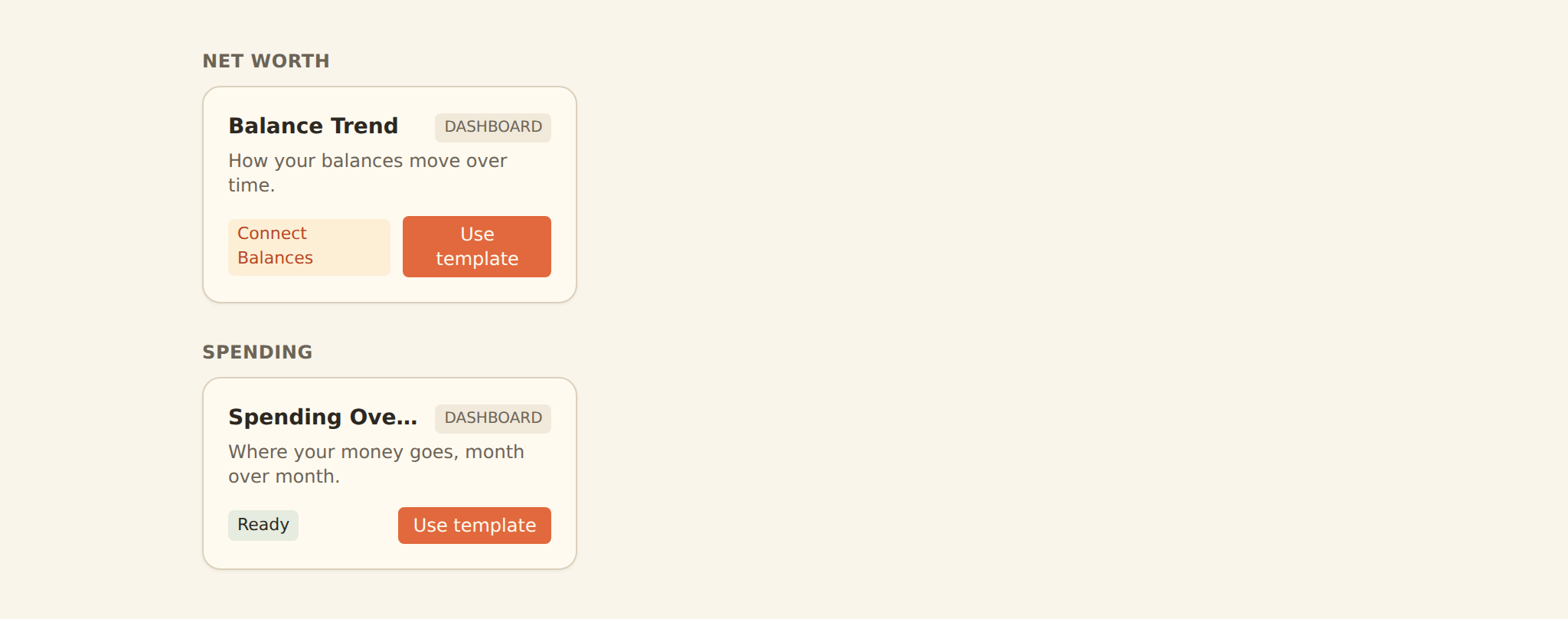
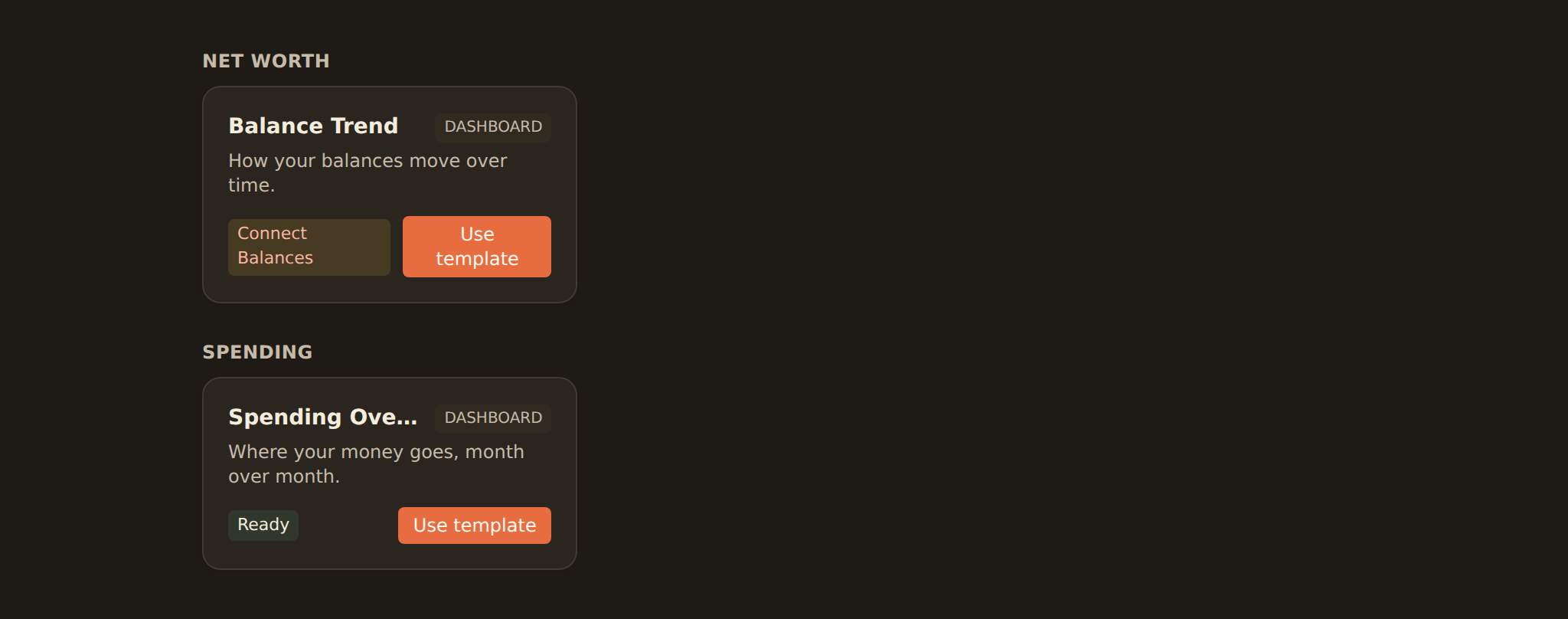
Use a template
Pick a template
Browse the gallery and choose one that matches what you want to track.
Connect your data
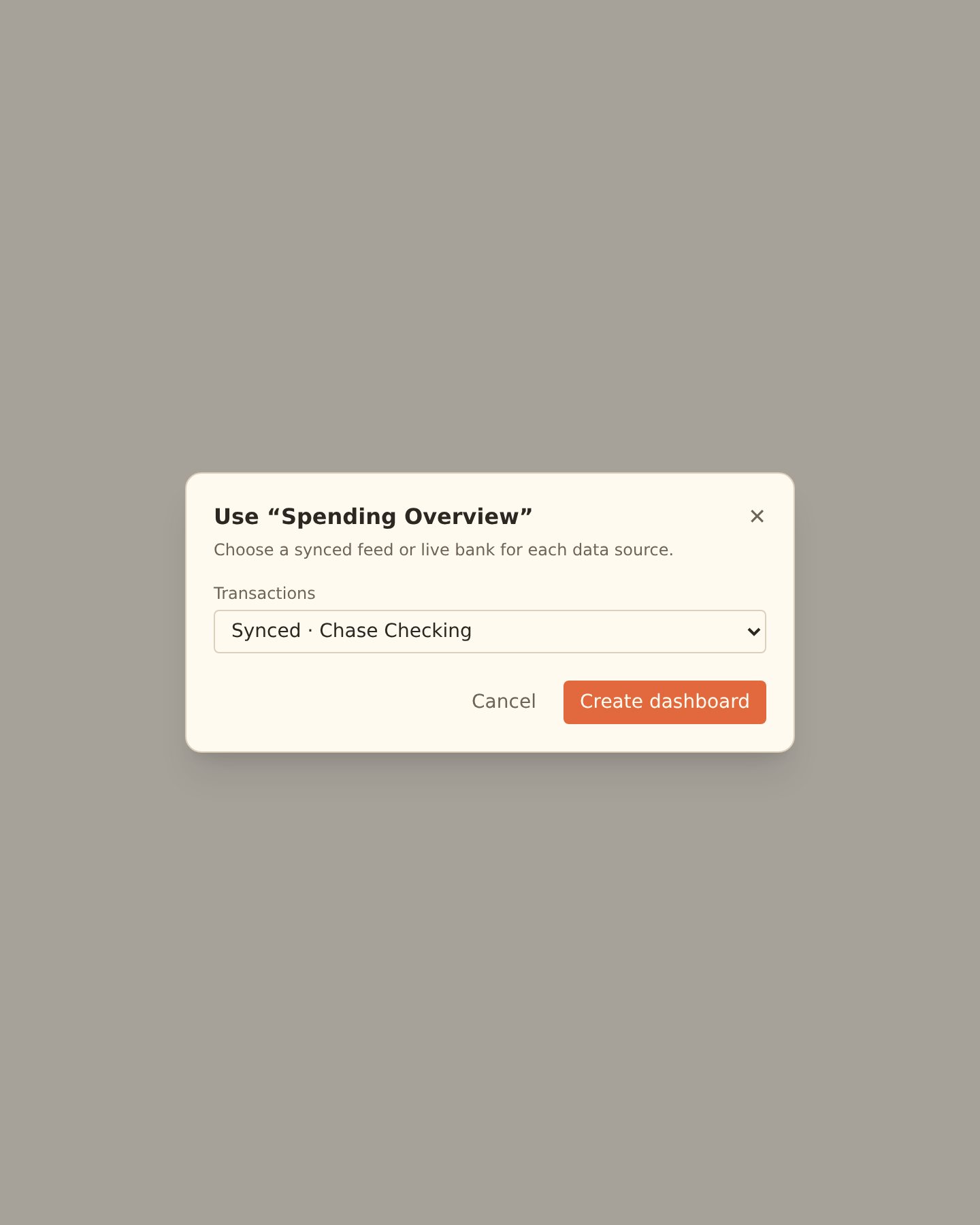
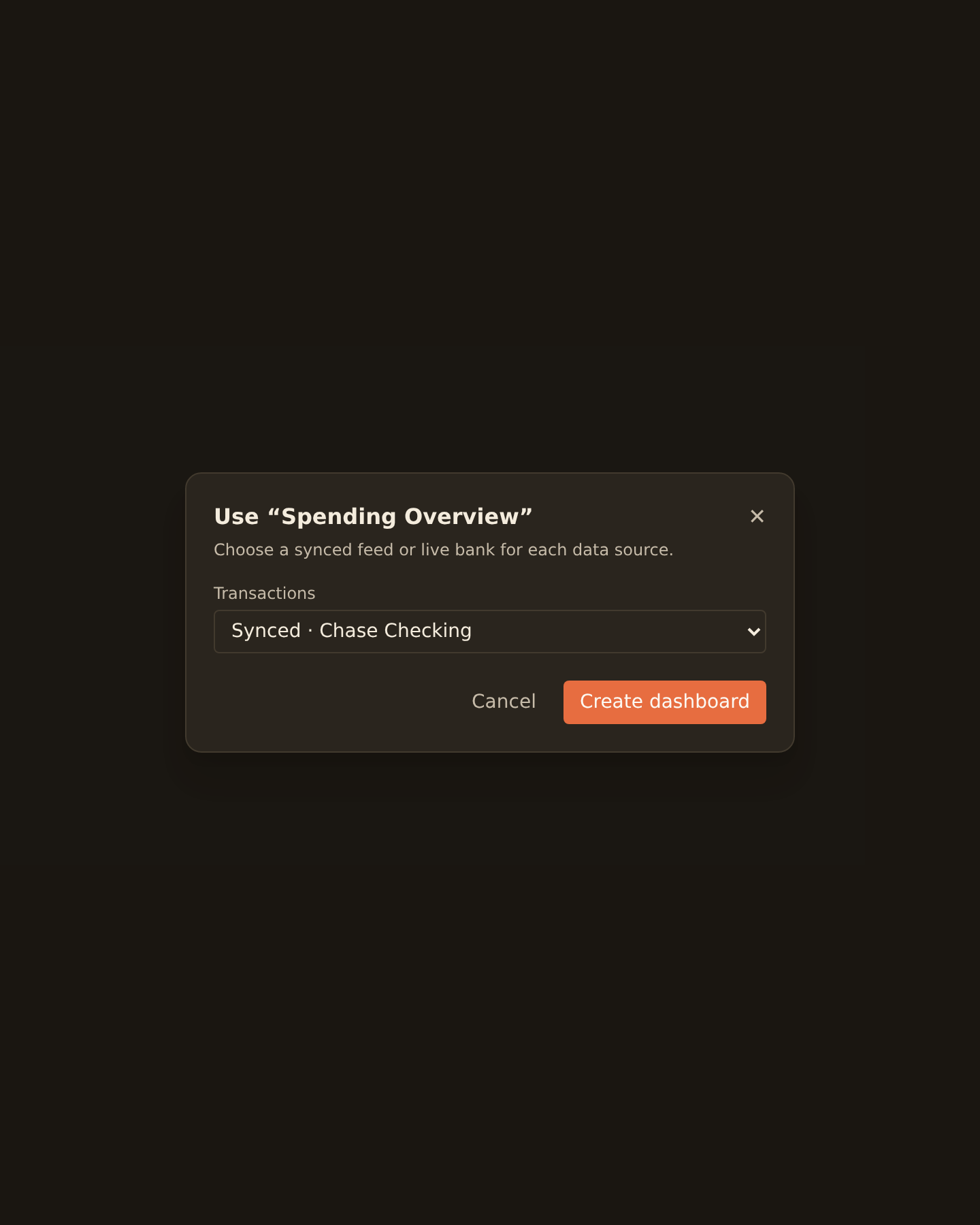
For each resource slot, choose a compatible synced feed or live bank. Older feed-only templates continue to show feeds only.
Create the dashboard
BankSync validates the complete graph before it writes. Required resources must resolve; optional missing resources become unconnected widgets at their intended layout positions.
Tweak it
Edit any widget exactly as if you had built it yourself.
Templates need a compatible source
Review drafts protect your current dashboard
Penny proposals and template updates open as private review drafts. The review reports ready, setup-needed, temporarily unavailable, and invalid items. Keep or Adopt revalidates the current source revisions before promotion; Discard removes only resources owned by that draft. Ordinary manual dashboard edits continue to autosave and never gain a Save or Keep step.
One explicit source per slot
Legacy templates remain feed-only
Worked example: Spending Overview#
Say you want a quick monthly view of where your money goes.
- Open the gallery and pick Spending Overview.
- In the connect step, the template needs one transactions slot. Choose your Chase Checking transactions feed from the picker.
- Click Create dashboard.
BankSync mints a real dashboard with the template's widgets (for example Spend by category and Net cash flow) already filled in with your Chase Checking numbers. From there you can resize widgets, swap the feed, or add your own, exactly as if you had built it from scratch.
Saving your own template#
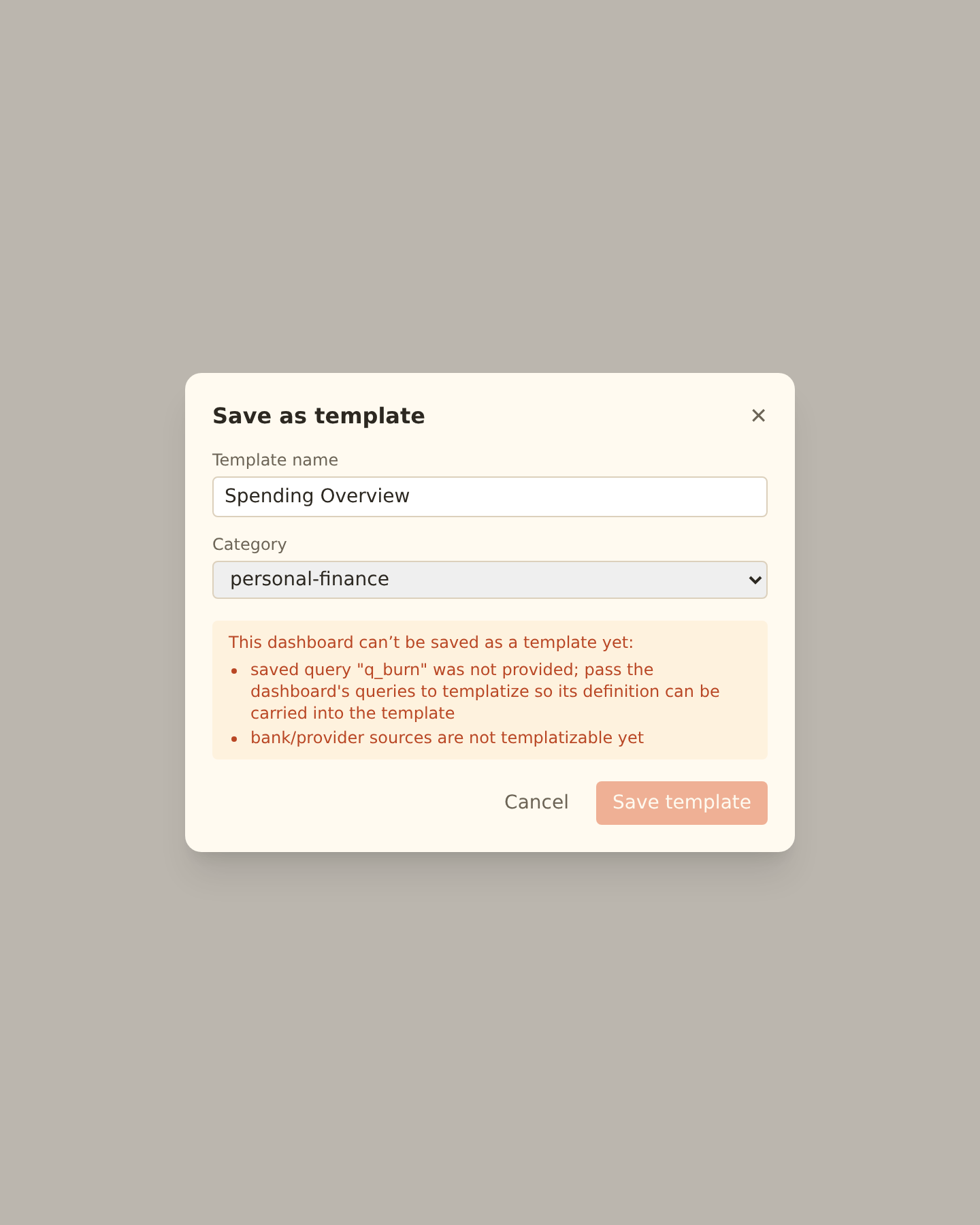
Built a dashboard you want to reuse or share? Save it as a template. BankSync lifts concrete feed and live-bank leaves into logical resource slots. The portable body retains resource types, semantic field requirements, transforms, and layout, but removes bank, account, feed, and workspace IDs. The installer chooses fresh local sources. (Today you save at the whole-dashboard level: there's no "save this one widget as a template" button in the app yet, even though individual widgets have their own Share tab.)
Portability checks
- A widget that has fields set but no data source to connect them to.
- A widget using a saved query that can't be carried over to another workspace.
- A cross-filter that points at a filter that no longer exists.
Sharing a template#
Saving a template keeps it to yourself. To let others use it, open it from My templates and choose Publish. The publish dialog lets you set:
- Visibility, one of four levels:
- Private, only you.
- Workspace, anyone in this workspace.
- Public link, anyone who has the link.
- Public, listed in the template marketplace so others can discover it.
- A category and up to eight tags (chosen from set lists, so the marketplace stays tidy).
Before it lets you publish, BankSync runs the same portability check plus a safety check, and shows the result right in the dialog. If either check fails, it lists what to fix. When you publish at one of the public levels, BankSync mints a share link (a short /t/... URL) you can hand out.
So the dialog gathers all of this in one place: the visibility level, the category and tags, the pass-or-fail portability and safety results, and (for public levels) the resulting share link.
Share links are always real
Managing and updating#
Your saved templates live under My templates, a list showing each template's name, category, publish state, and visibility, with the Publish and state-transition actions sitting on each row. From here you can Publish a template (opens the share dialog above) or move it through its publish states (for example Draft to Published, or Published to Deprecated or Unlisted). There is no in-place edit or delete in this view today: to change what a template contains, save a fresh template from an updated dashboard.
When a template you created a dashboard from gets a newer version, the dashboard shows a friendly A newer version is available banner with Review update and Dismiss actions. Reviewing builds the latest version into a brand-new draft and shows you the differences side by side. It never overwrites the dashboard you've already tweaked, so your edits are safe and you decide whether to adopt the new version.
Build templates with an agent
Related guides#
- Creating your first dashboard: the blank-canvas alternative.
- Binding data: how connecting a widget to a synced feed or live bank works under the hood.
- Publishing & sharing: publishing a finished dashboard or widget (separate from publishing a template, which is covered above).
Connect your data
Use this page with your AI assistant
Every BankSync doc is available as plain Markdown for agents and LLMs.