

Persist every accepted baseline, settled bill and adjustment in your own system of record. Your savings total can then be rebuilt after a corrected invoice or a model change. The local model explains that total using selected evidence, and the ledger preserves how it was calculated.
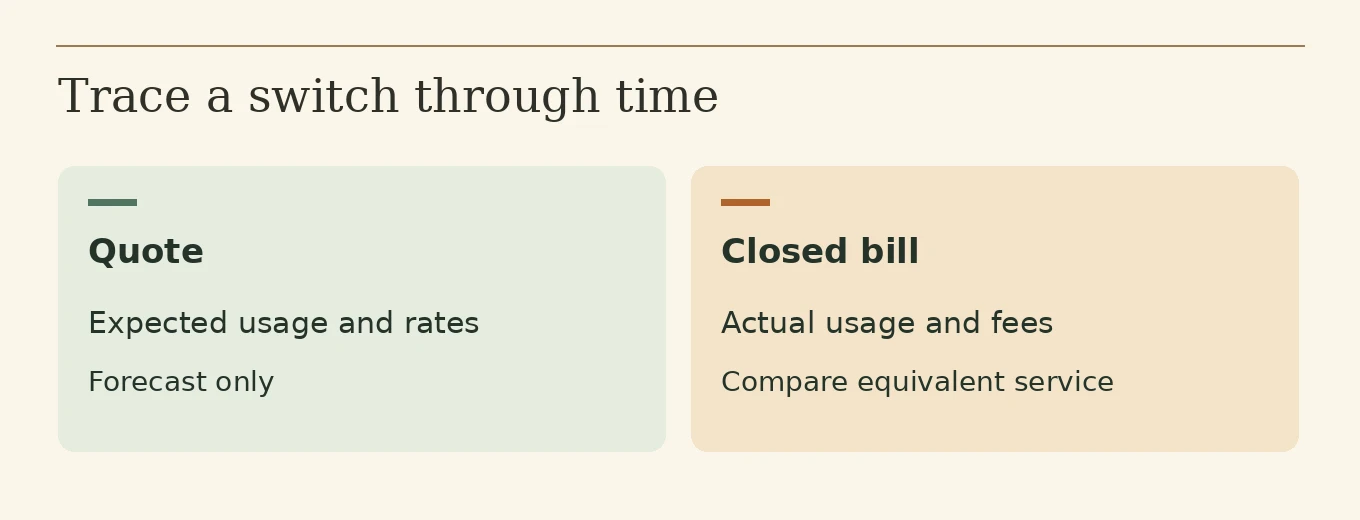
A provider quotes an annual saving. Three months later, how much of it reached the household? A useful savings ledger keeps the quote, the switch and each closed billing period as separate records. It compares actual new charges with what the old terms would have cost for the same service and usage.
Write down the counterfactual before switching
Keep the old tariff or premium, its effective dates, the service scope and the reason it is a valid comparison. A temporary discount that was about to expire is a poor twelve-month baseline. If the old contract would have renewed at a different rate, document that rate or show a range. Keep source documents locally so a published tariff disappearing does not erase the basis of the calculation.
For a usage-based service, price actual consumption at the old rates. For a fixed subscription, compare the same number of service days or billing cycles. Split periods that straddle a switch. When coverage, speed or service level changed, label the difference so it cannot be mistaken for a like-for-like saving.
Reconcile the first bill
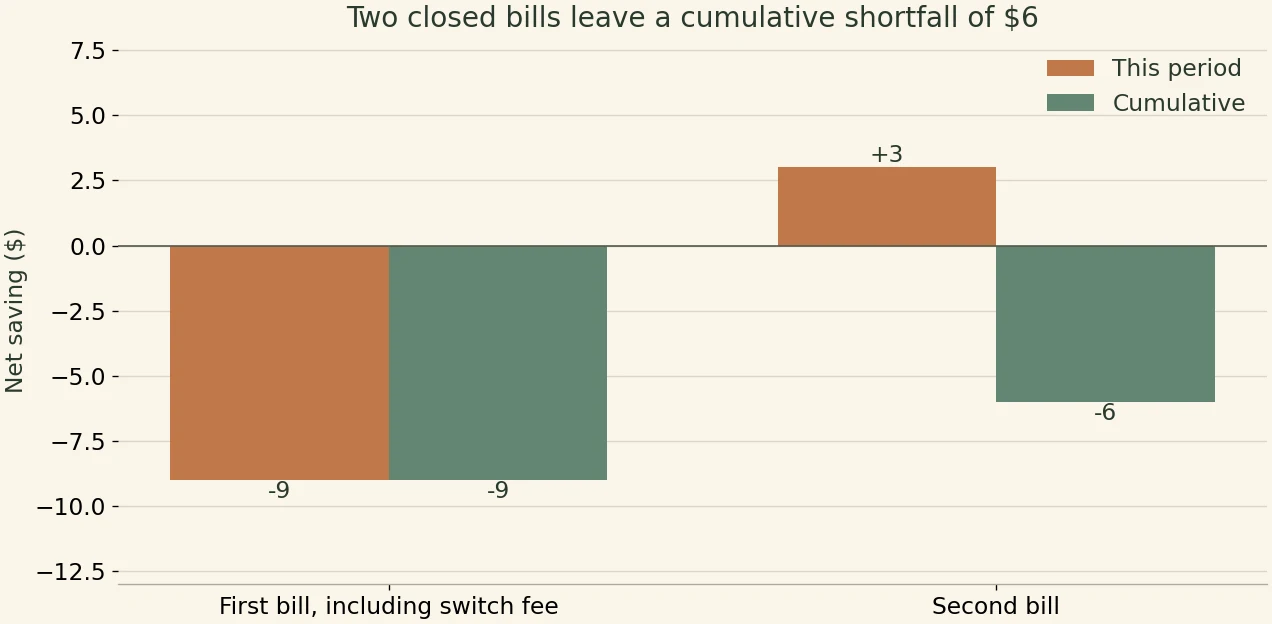
Imagine that 30 days of actual electricity usage would have cost $126 under the old tariff. The new invoice charges $123. A separate $12 switching fee was paid once. The first period's net saving is $126 − $123 − $12 = −$9. An honest report shows the household spent $9 more over that period. If the next equivalent period again saves $3 with no additional fee, cumulative savings move from −$9 to −$6.
Keep credits consistent. If the $123 invoice is already net of a welcome credit, do not add the credit a second time. If a separately paid rebate is part of your measure, include it once when received and keep a link to the payment. A forecast rebate can sit beside the realised figure with its own status.
Savings ledger for a fictional switch
| Settlement | Old-equivalent cost | New payment and resulting saving |
|---|---|---|
| Period one | $126 | $123 bill + $12 fee gives −$9 |
| Period two | $126 | $123 bill gives +$3 |
| Both closed periods | $252 | $258 paid in total gives −$6 |
Use three small tables
A switch record identifies the service and effective date. A baseline_version holds old rates, units and the source document. A settlement record holds service dates, actual usage, old-equivalent cost, new cost, separate fees or credits, currency and evidence IDs. Give each service and invoice period an identity so a repeat import updates the same settlement.
BankSync can supply the posted payment to match against the invoice. A bank date may be days after the service period and one debit may settle several items. Keep the reconciliation link explicit. A local model can explain a negative month using the verified fields. It does not need the original account number or authority to edit the calculation. BankSync transaction behaviour
Keep the savings query reproducible
One local convention uses net_saving = baseline_cost - actual_net_cost - separate_fees + separately_received_credits. Keep a sign convention next to the table definition. A negative value means the household spent more. Preserve both a period ID and the version of the terms used to price it, because replacing last year's tariff with today's terms will rewrite history.
Close the savings ledger for a billing period
Close a period
Match the billed usage and dates to the accepted offer. Put disputed or missing bills into review.
Check the cumulative total
Sum only closed, comparable periods in the same currency. Keep the original forecast visible in a separate field.
Correct a bill
Supersede the earlier result with a reference to the revised invoice. Recompute the cumulative chart and preserve the reason for the change.
Read the chart as a household decision
A figure labelled “$36 per year if usage stays the same” is useful on the day of the quote. Later, the household needs a line labelled “net saving through the last reconciled bill”, with the coverage period underneath. Show gaps in that line when evidence is missing. A continuous curve across missing bills would suggest more certainty than the system has.
Continue building with Compare Electricity Tariffs With a Local AI Bill Analyser and Compare Home Insurance Renewals With a Local LLM.