

Keep a local record of the policy versions, verified coverage fields and decisions you make at renewal. That record lets next year's review pick up where this year's finished. A local model can help you read the documents while their personal details remain inside the inference environment you control.
At renewal time, use a local model to turn two insurance documents into a short list of differences you can verify. The premium in your bank feed is a starting point. It tells you the price paid, while the schedule and policy wording tell you what the household bought.
Keep the policy documents inside the review process
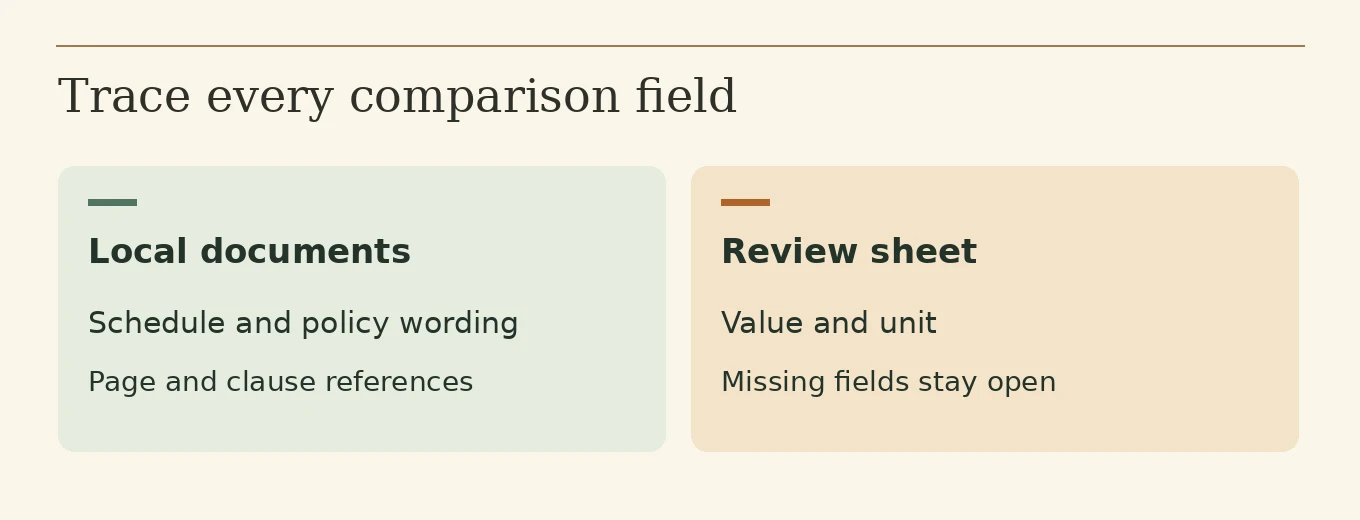
Save the current schedule, renewal notice, proposed quote and applicable policy wording on local storage. Record provider, document version, effective dates and relevant page references. Run PDF text extraction or OCR locally if the files are scanned. Check a sample against the page image: a dropped zero in a coverage limit matters more than a misspelt heading.
Ask the model for each field's value, unit, exact document location and a missing-value state. Keep personal addresses and policy numbers out of the summary display. A sourced field might read “storm damage excess: see schedule, page 2.” If a number appears in a brochure and the schedule disagrees, mark the conflict for a person to resolve.
Compare the trade the price actually buys
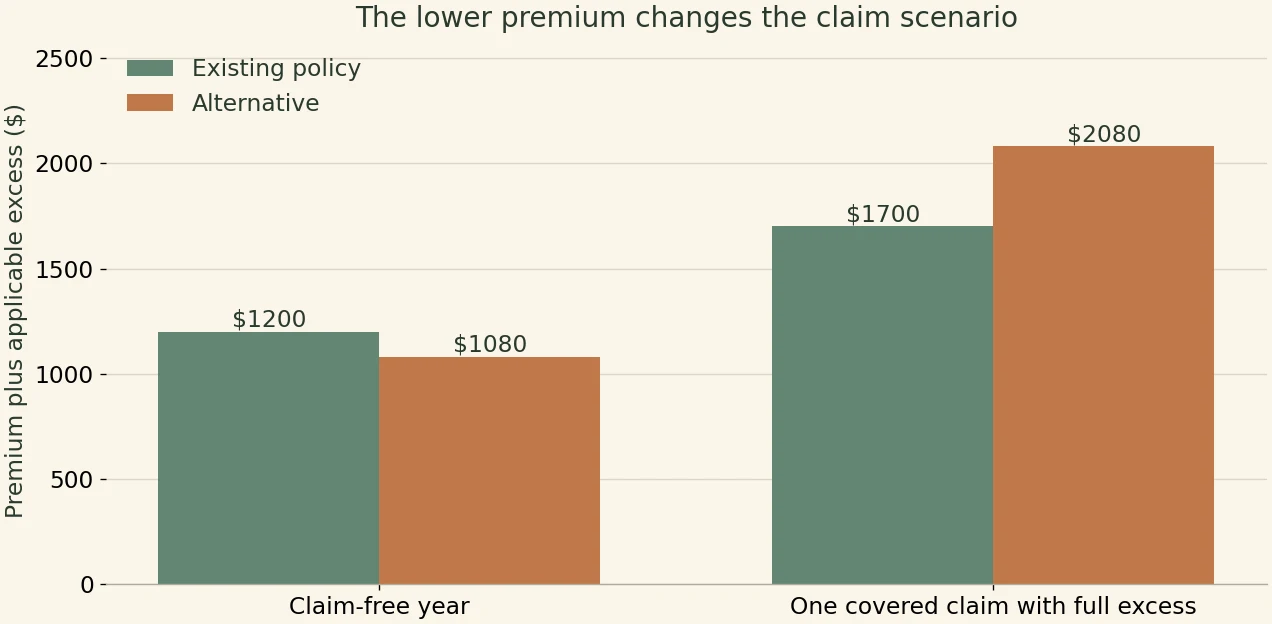
Consider two illustrative home insurance quotes. The existing premium is $1,200 a year with a $500 excess. The alternative costs $1,080 with a $1,000 excess. In a claim-free year, the premium difference is $120. In a simplified scenario with one identical covered claim large enough for the full excess to apply, premium plus excess is $1,700 versus $2,080. The second option costs $380 more in that scenario. This is a sensitivity check, not a prediction of a claim.
Now compare the insured amount, covered events, sublimits, exclusions, waiting periods, excesses by event and payment frequency. Monthly instalments may carry fees. The same premium can buy materially different cover. Australia’s Moneysmart guide explains the importance of checking excesses, exclusions and cover limits. Choosing home insurance
Fields to compare before accepting a quote
| Field | Evidence to retain | Reason to pause |
|---|---|---|
| Sum insured | Schedule and replacement basis | Rebuild protection differs |
| Excess | Amount for the relevant event | Premium saving shifts risk to household |
| Exclusions and sublimits | Clause plus page | Quotes may describe different protection |
| Payment frequency | Annual total including fees | Instalments can change the comparison |
Design the tool to preserve a disagreement
Store one comparison row per coverage item. Give it a left and right value, document references, a review state and a human note. When the model cannot locate a flood provision in the quote, store “not found in supplied document”. Treating that as “excluded” would be as misleading as treating it as “covered”. A person can request the full wording or ask the insurer for clarification.
Public comparison pages can supply a shortlist. Keep browsing and price discovery separate from the private document reader. An indicative public price has less evidential value than a dated quote issued for the household's actual circumstances.
A prompt suitable for a small local model
Ask for a single field at a time: “Locate the excess for the specified event. Return the amount, currency, page and a short supporting passage. If the event is absent, return missing.” Validate the page and passage against the locally extracted document. Small chunks need enough surrounding context to preserve endorsements or exceptions that alter the main clause.
Before replacing a policy
Normalise the cost
Put premiums on the same annual basis including instalment fees, and preserve original payment dates.
Flag consequential differences
Require a human review for narrower cover, larger excesses, missing exclusions and changes to the sum insured.
Record the decision
Save the accepted quote version, commencement date and first bill. Confirm coverage timing with the provider before ending the previous policy.
How to record the outcome honestly
If the household accepts less cover for a lower premium, label the result “premium reduction with changed cover”. Record the changed terms alongside the dollar figure. A local review sheet earns its place when it helps somebody ask the insurer one precise question that the renewal email left unanswered.
Continue building with Track Actual Savings After Switching Providers and Find Subscription Price Increases With a Local LLM.