

A local finance system gives you a durable ledger, repeatable calculations and control over the machine that reads your financial context. Those benefits matter when you want to correct a category once, revisit a decision months later or replace the assistant without rebuilding your financial history.
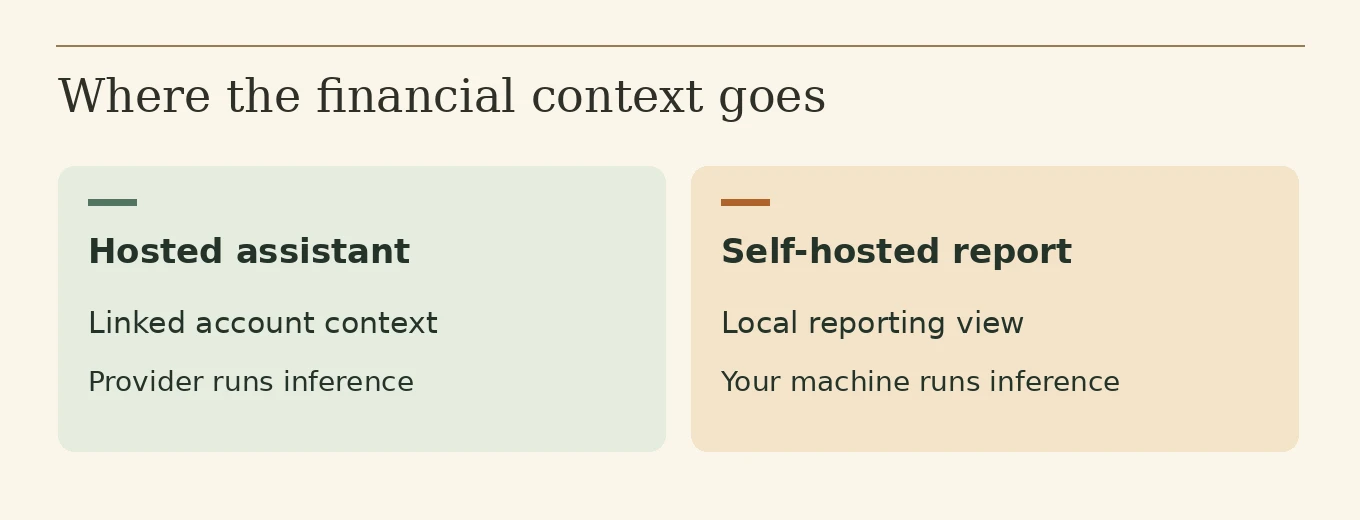
Should you connect your accounts to Claude, use Finances in ChatGPT, or run a model at home? Try the same question on paper first: “How much did we spend on groceries last month, after refunds?” A hosted product takes care of connecting and presenting the accounts. A home server gives you control of the definition of groceries, the retained rows and the machine that sees the prompt.
What Personal Finance in Claude can see
Anthropic announced its US beta on 5 November 2026 for Pro, Max and Ultra. Its help centre describes a read-only Plaid connection for balances and transaction history. A household can ask about a merchant without first writing a query. One limitation matters to homelab builders: the documented beta cannot use linked accounts in scheduled tasks or Claude Code. Building software with Claude Code is a separate workflow.
Anthropic says chats in the Personal Finance hub are excluded from model training. Those conversations still have a history. Unlinking a bank stops future access, and deleting an existing conversation is a separate decision. Read the product-specific controls before sharing household accounts. Anthropic launch · Personal Finance help
What Finances in ChatGPT gives you
OpenAI's US experience connects supported accounts through Plaid and presents spending, subscriptions and balances. Its October rollout update describes Free and Go access following Plus and Pro, as well as weekly updates and manual accounts. For someone who wants a ready-made spending view on their phone, that removes several evenings of setup. Check eligibility in your account because these rollouts are regional.
A dashboard can only describe the accounts it has. If the joint card has stopped refreshing, inspect its last sync before interpreting a drop in spending. OpenAI also distinguishes disconnecting an account from deleting conversations containing financial information. OpenAI announcement and rollout updates · Finances help
Which personal finance setup fits the job?
| Question | Claude or ChatGPT | Local BankSync build |
|---|---|---|
| Who runs the model? | Anthropic or OpenAI processes the permitted context | A runner you configure on your own hardware |
| Can I start with a US bank? | Check the native product's account and rollout eligibility | Check BankSync coverage and account eligibility |
| Who operates the report? | The provider maintains the hosted dashboard | You own the query, schedule, backups and corrections |
| Can I work from existing local files? | Uploading or connecting data shares selected context with the service | A CSV adapter can analyse files entirely on the LAN |
Where a local model earns its keep
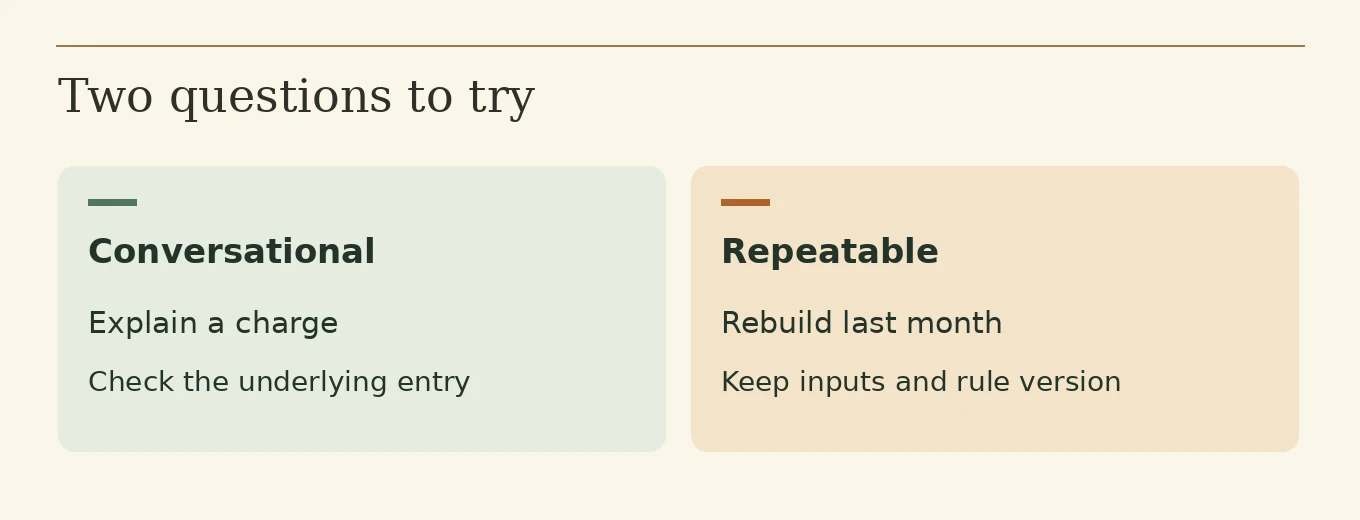
Consider a couple who reimburse each other for groceries. Their bank records contain the shop purchase and a transfer between partners. They want to count the purchase once, carry late refunds into the period they choose and rerun last month under the same rule. A local database can preserve the source entries, both people’s corrections and the version of the calculation. A model can explain that result using selected totals. The household takes responsibility for permissions, upgrades and recovery.
For a European reader, the US availability of the native products is an immediate selection criterion. The separate BankSync route depends on your particular institution, account type and consent. Check a real account before planning a whole build. BankSync coverage
Can I use the native features in Canada, Australia or Europe?
The linked launch and help pages describe US availability for the native connected-account experiences. Someone in Canada or Australia searching for those features should check the current eligibility page before choosing a plan. A working general-purpose chat account does not establish eligibility for bank linking. For the local route, check a supported institution and the specific account you need in BankSync, or begin with an exported file.
Test the same household question three ways
Try a familiar charge
Check whether the answer identifies the account, period and a transaction you can recognise.
Test a missing account
Remove one input from a synthetic report. A useful answer mentions incomplete coverage before drawing conclusions.
Ask for a rerun
If a corrected refund changes last month, determine whether you can reconstruct both the original and revised figure.
Choose around the question you will ask twice
If your priority is a conversation about this month, start with the eligible hosted experience that covers your accounts and whose data controls suit you. If your priority is a repeatable household rule, an offline explanation or a private dashboard sensor, the local build has a concrete purpose. Time the setup and a restore rehearsal as part of that choice. A service that someone else in the household can recover may be worth more than an extra chart.
Continue building with Build a Self-Hosted AI Finance Dashboard With Local Models and Build a Private Finance App With Claude Code or Codex.